
In many manufacturing environments, operators use heavy handheld tools—angle grinders, sanders, polishers, drills, and nutrunners—for hours at a time. Even when a tool only weighs 10–20 lb (4.5–9 kg), holding it continuously leads to fatigue, reduced control, and increased risk of injury.
The challenge isn’t just the weight—it’s the combination of:
-
static load (holding the tool up)
-
torque reaction (twisting force during operation)
-
repetition over long shifts
Supporting these tools properly is essential for maintaining productivity, quality, and operator health.
The Real Problem with Heavy Power Tools
Holding a heavy tool for extended periods creates static muscle load, which is one of the primary causes of fatigue in manufacturing.
Unlike lifting a part once, tool use often involves:
-
continuous holding
-
fine control
-
repetitive motion
-
vibration exposure
Over an 8-hour shift, even a relatively light tool becomes physically demanding.
Common Problem Scenarios
Grinding in Metal Fabrication
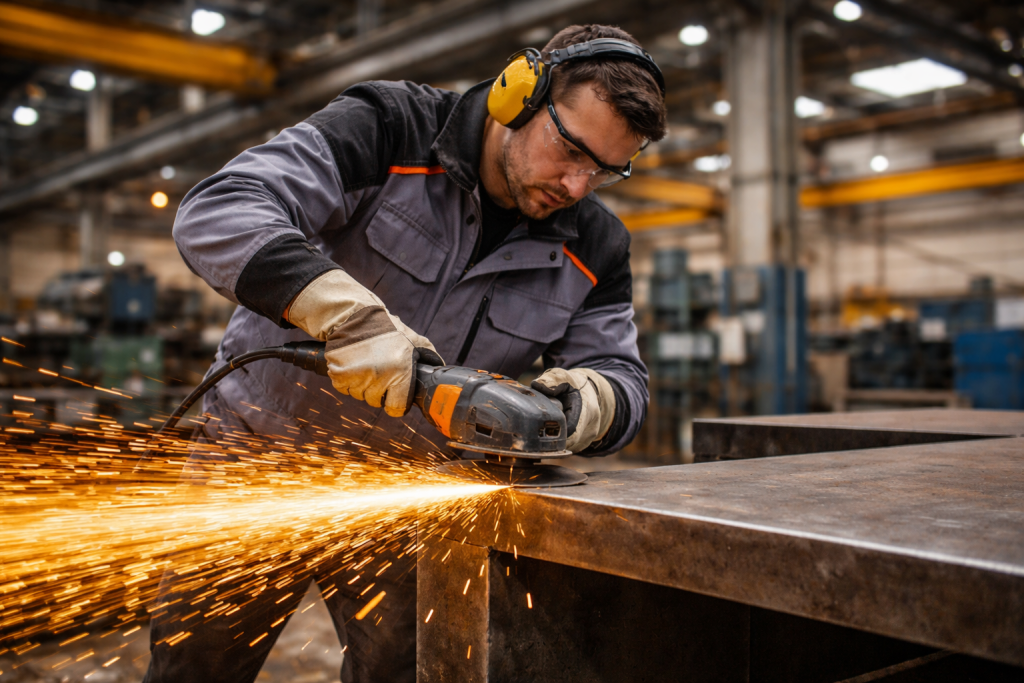
Operators using electric angle grinders to clean welds or break edges must hold the tool steady while applying consistent pressure.
Challenges:
-
tool weight pulling downward
-
vibration through the hands
-
maintaining consistent contact
Sanding and Finishing in Aerospace or Composites
Operators use orbital sanders or pneumatic polishers for extended finishing cycles.
Challenges:
-
fatigue from holding tools at awkward angles
-
inconsistent surface finish due to fatigue
-
repetitive strain injuries
Assembly with High-Torque Tools
Operators using pneumatic or electric nutrunners must control both weight and torque.
Challenges:
-
torque reaction twisting the operator’s wrist or shoulder
-
difficulty maintaining alignment
-
fatigue reducing fastening accuracy
Why Fatigue Matters More Than Most People Realize
Fatigue doesn’t just affect the operator—it affects the entire process.
As fatigue increases:
-
tool control decreases
-
surface finish becomes inconsistent
-
cycle times slow down
-
error rates increase
In many cases, what looks like a tooling or process issue is actually an ergonomic problem.
The Best Ways to Support Heavy Power Tools
There are several approaches to supporting tools during long shifts. The right solution depends on the tool, the process, and the level of precision required.
1. Tool Balancer Arms (Most Effective for Continuous Tool Use)
Tool balancer arms are designed specifically to support handheld tools.
They:
-
carry the weight of the tool
-
absorb torque reaction
-
allow the operator to guide the tool instead of holding it
Where They Work Best
-
grinding and sanding operations
-
polishing and finishing
-
drilling applications
-
assembly with moderate to high torque
Example
In a metal fabrication shop, an operator using a 15 lb angle grinder for weld cleanup can use a tool balancer arm to:
-
eliminate most of the tool weight
-
reduce fatigue over long shifts
-
maintain more consistent pressure on the surface
The result is better finish quality and less operator strain.
2. Torque Reaction Arms (For High-Torque Assembly)
Torque reaction arms are designed to absorb rotational forces generated by tools like nutrunners.
They don’t necessarily support full tool weight but are critical when torque is the primary issue.
Where They Work Best
-
automotive assembly
-
heavy equipment manufacturing
-
bolted joint applications
Example
In an assembly line using a high-torque electric nutrunner, a torque reaction arm:
-
prevents the tool from twisting in the operator’s hands
-
improves fastening accuracy
-
reduces wrist and shoulder strain
3. Overhead Tool Balancers (Simple Weight Support)
Traditional spring balancers suspend tools vertically from above.
They are a simpler solution but have limitations.
Pros
-
low cost
-
easy to install
Limitations
-
limited range of motion
-
no torque control
-
less precise positioning
These are often used for:
-
light tools
-
simple repetitive tasks
4. Workstation Design Improvements
Sometimes the best support solution isn’t just the tool—it’s the entire workstation.
Improvements include:
-
adjusting work height
-
reducing reach distance
-
positioning parts closer to the operator
-
improving tool access angles
These changes reduce strain but usually don’t eliminate the need for tool support systems.
Tool Balancer Arms: Supporting Both Weight and Torque
Modern tool balancer arms combine two critical functions:
-
weight support
-
torque reaction control
This makes them especially effective for tools like:
-
angle grinders
-
pneumatic sanders
-
polishing tools
-
nutrunners
Instead of separating solutions, a single system can:
-
stabilize the tool
-
reduce fatigue
-
improve control
What Happens When You Don’t Support Tools Properly
Without proper support, operators often compensate in ways that create additional problems:
-
gripping tools tighter → increased fatigue
-
leaning into the tool → poor posture
-
reducing pressure → inconsistent results
Over time, this leads to:
-
higher injury rates
-
lower productivity
-
more rework
How to Know If You Need Tool Support
There are clear signs that a tool support solution is needed:
-
operators frequently switch hands due to fatigue
-
inconsistent finish or quality
-
complaints about tool weight or strain
-
visible struggle controlling the tool
-
reduced productivity over long shifts
If any of these are happening, the issue is likely ergonomic—not just operational.
Real Impact: What Changes When Tools Are Supported
When heavy tools are properly supported, manufacturers typically see:
Improved Consistency
Operators can maintain steady pressure and positioning.
Reduced Fatigue
Less physical strain over long shifts.
Higher Productivity
Operators work more efficiently without fatigue slowing them down.
Better Ergonomics
Reduced risk of repetitive strain injuries.
The Key Takeaway
Supporting heavy power tools isn’t just about comfort—it’s about performance.
For operations involving grinding, sanding, polishing, drilling, or fastening:
-
tool weight
-
torque reaction
-
repetitive motion
all combine to create fatigue and variability.
The most effective solution is one that:
-
supports the tool’s weight
-
stabilizes torque forces
-
allows natural, controlled movement
In most cases, that means using a properly configured tool balancer arm system designed for the specific tool and application.
Frequently Asked Questions
What is the best way to support a heavy grinder?
The most effective solution is a tool balancer arm, which supports the tool’s weight and allows the operator to guide it with minimal effort.
Do torque reaction arms replace tool balancer arms?
No. Torque reaction arms are designed to absorb rotational forces, while tool balancer arms support tool weight. Some systems combine both functions.
Are overhead tool balancers enough for heavy tools?
They can help with lighter tools, but they typically lack the range of motion and torque control needed for heavier or more complex applications.
How much can tool support improve productivity?
While results vary, reducing fatigue often leads to more consistent performance and faster cycle times, especially in repetitive operations.
Can lighter tools still benefit from support?
Yes. Even lighter tools can cause fatigue over long shifts due to repetition and sustained use.
If your operation involves long-duration tool use, supporting those tools properly can make a measurable difference in quality, productivity, and operator well-being.
